





2027 Tax Reform: Income Tax Law and Federal Revenue Law
- Blog /
- 2027 Tax Reform: Income Tax Law and Federal Revenue Law bills
Published on Monday, September 14, 2026
DOCUMENT STATUS
Bill pending legislative approval. Its content may change during the parliamentary process. Proposed effective date: 1 January 2027.
The proposed 2027 Tax Reform introduces significant changes that could aqffect the tax calculation of both individuals and legal entities. Below is an overview of the main measures included in the initiative.
The four highest-impact amendments
The bill reshapes the corporate income tax base. Four amendments carry most of the economic effect; much of the remaining package follows from them or compensates fot them.
1. New general cap on allowable deductions
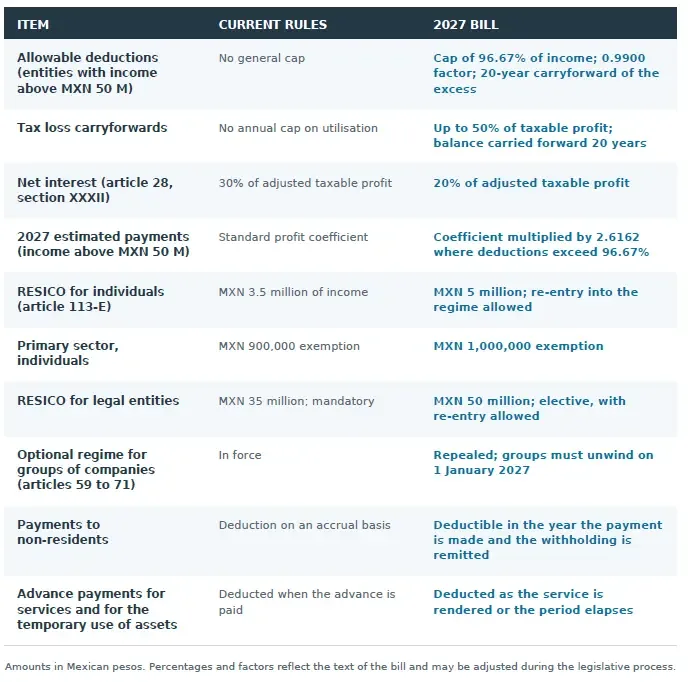
A new chapter X is added to Title II (Articles 78-A to 78-F). Where deductions are equal to or lower than 96.67% of taaxable income, only the result of multiplying them by 0.9900 may be deducted; where they exceed that that percentage, the cap is 96.67% of income. The excess may be carried forward for 20 years, is restated under article 78-B, is a personal right that cannot be transferred through a merger or spin-off, and does not qualify as a tax loss.
2. 50% cap on the use of tax loss carryforwards
Tax losses from prior years may only offset up to 50% of the taxable profit for the year, after applying the deduction cap. The unused balance is carried forward for the following 20
years.
3. Net interest deductibility reduced from 30% to 20%
Article 28, section XXXII is amended to lower the net interest deduction limit from 30% to 20% of adjusted taxable profit. The effect is direct on structures with intercompany financing or material leverage.
4. Substantial expansion of the simplified regime (RESICO)
Individuals: the income threshold rises from MXN 3.5 to 5 million, with updated monthly and annual tables and the ability to re-enter the regime. Legal entities: the threshold rises from MXN 35 to 50 million and the regime ceases to be mandatory, becoming elective.
Who does the new control mechanism apply to?
Mexican-resident legal entities with taxable income above MXN 50 million that report a taxable profit for the year.
Current rules versus the bill
Comparison of the thresholds and limits amended by the bill.
Other relevant amendments and immediate actions
Capital, shares and tax accounts
Accrued but unpaid interest and the VAT relating to capitalised liabilities no longer form part of the tax basis of shares or of the paid-in capital account (CUCA). In-kind contributions consisting of receivables, assigned collection rights or credit instruments only take effect once realised and up to the amount actually collected. The net after-tax profit account (CUFIN) is reduced by items that fail to meet tax requirements, and supporting documentation is required for capital increases.
Groups of companies
Chapter VI of Title II (articles 59 to 71) is repealed. Companies taxed under the optional regime as of 31 December 2026 must unwind the group on 1 January 2027. Deferred income tax must generally be remitted no later than 31 December 2027; the amount relating to the third preceding year, no later than 31 March 2027.
Investment incentives
Immediate depreciation of new fixed assets acquired between 1 January 2027 and 30 September 2030 is written into the law, with rates ranging from 49% to 89% depending on the asset and the activity, a minimum two-year holding period and a specific investment register. Office furniture and equipment, internal-combustion vehicles, armouring, assets that cannot be individually identified and certain aircraft are excluded. Incentives under Plan México and the Development Poles are moved into the law and
cannot be combined with one another or with other decrees.
Depreciation rates under RESICO for legal entities
Rates are doubled: computer equipment and tooling to 100%; office furniture and equipment, vehicles and freight transport to 50%; research and technological development to 70%; restaurants to 66%, among others. Investments made through 31 December 2026 keep their existing rates.
Recommended actions before the 2026 year-end
- Quantify the effect of the 96.67% cap and the 0.9900 factor on projected taxable profit.
- Review accumulated tax losses and reschedule their use under the 50% cap.
- Recalculate insterest deduction capacity at the 20% threshold and review financing arrangements.
- For groups of companies: plan the unwind and the deferred tax remittance calendar.
- Bring forward the 2027-2030 investment plan and assets whether the elective RESICO is advantageous.
The Kreston BSG Tax team is available to model the effect of these provisions on your specific position and to support decision-making before the year-end.
→ [Book a meeting with our specialists]
2027 Federal Revenue Law
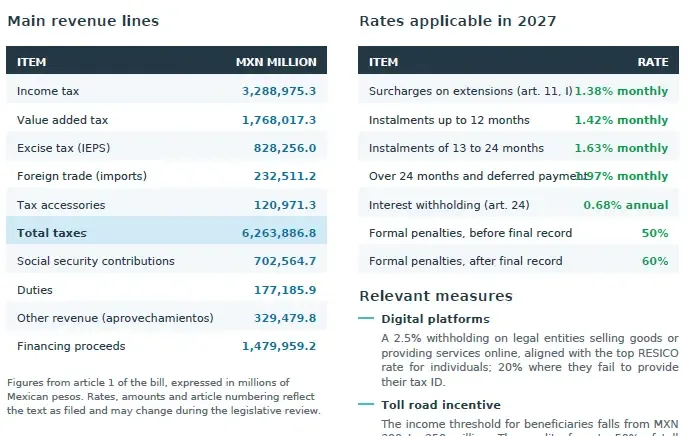
The Federal Revenue Law bill accompanies the income tax reform and sets the estimated collection figures, surcharge rates, interest withholding rate and tax incentives in force during the year.

Relevant measures
Digital platforms
A 2.5% withholding on legal entities selling good or providing services online, aligned with the top RESICO rate for individuals; 20% where they fail to provide their tax ID.
Toll road incentive
The income threshold for nebeficiaries fall from MXN 300 to 250 million. the credit of up to 50% of toll spending is retained, and related parties under article 179 of the Income Tax Law are excluded.
Diésel, biodiesel and mining
The diesel credits for business activities with income below MXN 60 million and for freight or passenger transport are retained, as is the credit for the special mining duty where income is below MXN 50 million.
Borrowing ceiling
Net domestic borrowing of up to MXN 1.7 trillion and net external borrowing of up to USD 13.5 billion.
The changes describes remain subject to the legislative discussion and approval process. Therefore, it is advisable to monitor the progress of the initiative and assets its potential impact on each specific situation.
Best regards;
Kreston BSG México
Author: Carlos Sierra, Tax Partner. Kreston BSG Querétaro
For more information, contact us at ventas@krestonbsg.com.mx or find your nearest office at www.krestonbsg.com.mx/contacto
Our goal is to build a network of trust with our clients to be the support in achieving business objectives. We are a network of firms with a presence in more than 110 countries, experts in offering tax, auditing, legal and accounting consulting services at national and international level. Everything written in this space is for the benefit of the readers; however, for a correct application of specific topics it is necessary to refer to our specialists. For more information visit www.krestonbsg.com.mx