





The concept of beneficial owner in tax treaties for the
- Blog /
- The concept of beneficial owner in tax treaties for the avoidance of double taxation entered into by Mexico
Published on Wednesday, September 2, 2026
This article analyzes the concept of beneficial owner in the tax treaties entered into by Mexico for the avoidance of double taxation, as well as its role as a requirement for access to the benefits provided by those instruments with respect to dividends, interest, and royalties.
To that end, it examines the origin of the concept in the Model Convention of the Organisation for Economic Co-operation and Development (OECD), its interpretation in light of the Commentary on the Model, the evidence that may be relevant to establishing beneficial ownership, the tax consequences of failing to meet this condition, and certain foreign judicial decisions that have helped define its scope.
What should be understood by beneficial owner for purposes of the tax treaties entered into by Mexico for the avoidance of double taxation?
The term beneficial owner was first incorporated into the 1977 OECD Model Convention in Articles 10, 11, and 12 as an anti-abuse rule arising from taxpayers’ use of conduit companies to obtain treaty benefits for people who were not residents of the Contracting States.
This concept is used in Articles 10 (dividends), 11 (interest), and 12 (royalties), which govern the taxation of such income and limit the source State’s right to tax it. Consequently, these are the provisions most susceptible to abusive arrangements involving residents of third States.

The term beneficial owner is not defined in the OECD Model Convention or in Mexico’s tax treaties, even though Article 3 contains several definitions for purposes of their application.
With respect to undefined terms, that article provides that they shall have the meaning assigned to them by the law of the State applying the treaty concerning the taxes to which the treaty applies, unless the context otherwise requires. In Mexico, because the tax covered by the treaty is income tax, the applicable legislation is the law governing that tax.
However, that law does not assign a meaning to the term beneficial owner. The reference in Article 3 therefore does not determine its scope, and recourse must be had to the general rules for interpreting international treaties set forth in the Vienna Convention on the Law of Treaties. As explained below, those rules require a treaty to be interpreted in good faith in accordance with the ordinary meaning of its terms, in their context, and in light of its object and purpose.
For this analysis, the content of Articles 31 and 32 of the Vienna Convention must first be presented and then used to determine whether the Commentary may be relied upon to interpret the term beneficial owner.
Article 31 provides as follows:
“A treaty shall be interpreted in good faith in accordance with the ordinary meaning to be given to the terms of the treaty in their context and in the light of its object and purpose.”
On the basis of this provision, it could be argued that the Commentary on the OECD Model Convention reflects the ordinary meaning that the Contracting States attributed to the term beneficial owner, because the treaty was negotiated on the basis of that Model and the Commentary was the instrument through which the OECD explained the scope of its provisions. Thus, if the States reproduced the term without defining it or departing from those explanations, it may be inferred that they used it in the sense attributed to it by the Commentary at the time the treaty was negotiated and concluded.
If the foregoing interpretation is not accepted, recourse may be had to Article 32 of the Vienna Convention, which permits the use of supplementary means of interpretation.
Article 32 provides as follows: “Recourse may be had to supplementary means of interpretation, including the preparatory work of the treaty and the circumstances of its conclusion, in order to confirm the meaning resulting from the application of Article 31, or to determine the meaning when the interpretation according to Article 31: (a) leaves the meaning ambiguous or obscure; or (b) leads to a result which is manifestly absurd or unreasonable.”
In other words, supplementary means may be used only after applying the general rule of interpretation in Article 31. Their function is not to replace the interpretation derived from the text, context, object, and purpose of the treaty, but to confirm that meaning or determine it when it remains ambiguous or obscure or leads to a manifestly absurd or unreasonable result.
Among these supplementary means, Article 32 expressly mentions the preparatory work and the circumstances surrounding conclusion of the treaty. The Commentary on the OECD Model Convention is not preparatory work for the bilateral treaty; however, the versions existing when the treaty was negotiated may be regarded as part of the circumstances of its conclusion because the treaty was negotiated on the basis of that Model and the Commentary explains the meaning and application of its provisions.
In this respect, the Commentary on the Model does not contain an express definition of beneficial owner. Instead, it explains the circumstances in which a person cannot be regarded as such. It states that a conduit company does not meet this condition, even if it is the legal owner of the income received, where its powers over that income are so narrow that, in practice, it acts merely as a fiduciary, administrator, or intermediary on behalf of another person.
A person is not the beneficial owner when its right to use and enjoy the income is constrained by a legal or contractual obligation to pass it on to another person. Conversely, where the recipient retains the ability to use and enjoy the income for its own account, without being legally or contractually required to transfer it to a third party, it should be regarded as the beneficial owner.
Accordingly, the analysis should focus not only on who formally receives the payment, but on who actually has the right to use and enjoy the income. As noted, representatives, nominees, fiduciaries, administrators, and certain conduit companies may be excluded from beneficial-owner status when acting on behalf of a third party.
The foregoing cases are not exhaustive, because different legal systems may recognize other arrangements that perform similar functions in practice.
It is important to note that the concept of beneficial owner used in tax treaties differs from that used in other fields, such as anti-money-laundering rules or regimes for identifying ultimate controlling beneficiaries. For treaty purposes, if an entity has the right to use and enjoy the income received for its own account, without a legal or contractual obligation to transfer it to a third party, it may be regarded as the beneficial owner. The analysis therefore does not seek to identify the individual who ultimately controls the entity.
The beneficial-owner rule is one of the anti-abuse measures contained in treaties. Action 6 of the BEPS Project developed other measures, including amendment of the preamble, the principal purpose test (PPT), and the limitation on benefits (LOB) rule, which were incorporated into the 2017 Model in the preamble and Article 29. Because most Mexican treaties were negotiated before that update, these measures may be incorporated into covered tax agreements through the MLI: the preamble amendment under Article 6 and the PPT or, where applicable, the simplified LOB under Article 7.
What evidence might be used to establish that a person is the beneficial owner?
The Commentary on the OECD Model Convention does not provide an exhaustive list of evidence for establishing beneficial-owner status. The relevant documentation will depend on the particular facts and circumstances of each case. Nevertheless, a defense file might include the following documents:

- Financial statements showing that the recipient of the dividends, interest, or royalties retains the income received and does not pass it on to a third party, and demonstrating that it conducts its own activities and does not principally function as a conduit company.
- The recipient’s income tax returns, to corroborate the information in the financial statements and the manner in which the income was recognized for tax purposes.
- A sworn written statement made before a notary public (affidavit) in which the recipient states that it does not act as an intermediary with respect to the income received and is not required, by law or contract, to transfer it to a third party.
- The multinational group structure, including the corporate organization chart, a description of the entities participating in the transaction, and the functions performed, assets used, and risks assumed by each. Documents explaining the allocation of economic activities within the group may also be considered, including, where relevant, information in the country-by-country report insofar as it helps demonstrate that the recipient conducts genuine activities and is not merely a conduit company.
- Agreements relating to the payments under review, as well as financing agreements, license agreements, and other legal instruments connected with the transaction, showing the absence of a legal or contractual obligation to transfer the income received to another person.
What tax consequences arise when the formal recipient of the payment is not the beneficial owner?
Articles 10, 11, and 12 limit income-tax withholding in the source State when dividends, interest, or royalties are paid to a resident of the other Contracting State.
Before the term beneficial owner was added to the OECD Model Convention in 1977, the limitation on the source State’s taxing right was linked to income being “paid to” a resident of the other Contracting State. This wording supported the view that it was sufficient for that resident to be the immediate or formal recipient of the payment, even when acting on behalf of another person. The beneficial-owner concept was introduced to prevent that purely formal interpretation of “paid to.”

Accordingly, if the formal recipient is not the beneficial owner, it will not be entitled to the benefits provided by Article 10, 11, or 12 of the treaty with respect to the relevant income.
The source State may therefore impose the withholding required by its domestic law without applying the treaty limitations in those articles. In that situation, juridical double taxation may arise if the same income is taxed both in the source State and in the residence State of the person entitled to treaty benefits.
Can a company that obtains third-party financing and makes loans to a company resident in Mexico be regarded as the beneficial owner of the interest?
Yes. Although this may appear inconsistent with the foregoing, a distinction must be drawn between an entity that receives income for its own account and one that acts solely as an agent, nominee, or conduct with respect to that income. The fact that a company is financed with funds obtained from third parties does not, by itself, mean that the interest it receives is subject to a contractual or legal obligation to be transferred to those third parties.

According to the Commentary on the OECD Model, the fact that an entity obtains financing from a bank or any other third party and uses the funds to make a loan to an entity resident in Mexico does not, by itself, mean that it acts as a conduit company or ceases to be the beneficial owner of the interest it receives.
The Commentary on the OECD Model Convention distinguishes between an obligation to pass a received payment on to a third party—which may preclude beneficial-owner status—and the recipient’s own independent financial obligations to its creditors. An entity may therefore be the beneficial owner of interest it receives when it does not act as an agent, nominee, or conduit and is not legally required to transfer that same interest to another person.
How should the beneficial-owner concept be analyzed when fiscally transparent entities are involved?
A fiscally transparent entity is one that is not itself taxed on the income it earns; instead, the income is attributed for tax purposes to its partners, members, or participants. When such an entity is involved, the analysis must begin by identifying who derives the income for treaty purposes and may claim treaty benefits, before determining whether that person meets the beneficial-owner requirement in the articles concerning dividends, interest, and royalties.

Before analyzing beneficial ownership, it must be determined whether the treaty applies, because only residents of one or both Contracting States may invoke it. In the case of such entities, residence must be examined with respect to the persons to whom the income is attributed for tax purposes.
A resident of a Contracting State is any person who, under the laws of that State, is liable to tax there by reason of domicile, residence, place of management, or any other criterion of a similar nature. The State itself, its political subdivisions or local authorities, and pension funds recognized under the law of that State are also residents.
Accordingly, the partners, members, or participants must be examined to determine whether they are residents of a Contracting State and satisfy the other requirements for treaty benefits.
This conclusion requires determining whether, under treaties concluded before 2017, partners resident in a Contracting State could claim benefits with respect to income derived through a fiscally transparent entity, because those instruments did not expressly address that case. The issue is particularly relevant because Mexico concluded most of its treaties on the basis of pre-2017 versions of the OECD Model Convention. In those versions, Article 1 merely provided that the convention applied to persons who were residents of one or both Contracting States, without a specific rule for income derived through fiscally transparent entities. Paragraph 2 was added to that article only in the 2017 update to address the issue expressly.
That circumstance, however, does not necessarily mean that income derived through fiscally transparent entities was excluded from the benefits of those treaties.
The Commentary on the Model explains that paragraph 2 of Article 1 confirmed conclusions previously developed by the OECD regarding partnerships and extended their application to other fiscally transparent entities and arrangements.
The Introduction to the Model also rejects interpreting amendments to its articles or Commentary a contrario, as though the prior wording necessarily produced different consequences. In my view, therefore, the absence of paragraph 2 of Article 1 from pre-2017 treaties does not prevent income derived through a fiscally transparent entity from being attributed to its partners, members, or participants resident in a Contracting State where the applicable tax law attributes that income to them.
The determination of the person entitled to invoke the treaty is nevertheless distinct from identifying the beneficial owner of the income. The fact that income derived through a fiscally transparent entity is attributed, for treaty purposes, to one or more partners resident in a Contracting State does not, by itself, mean that those persons are the beneficial owners of that income.
On this point, paragraph 13 of the Commentary on Article 1 expressly states:
13. Even where the paragraph ensures that the various allocation rules of the Convention are applied to the extent that domestic law treats income derived through fiscally transparent entities as the income of a resident of a Contracting State, it does not prejudge the question whether the recipient is the beneficial owner. Where, for example, a fiscally transparent partnership receives dividends as an agent or nominee for a person who is not a partner, the fact that the dividend may be regarded as income of a resident of a Contracting State under that State’s domestic law does not prevent the source State from considering that neither the partnership nor the partners are the beneficial owners of the dividends.
As can be seen, the Commentary clearly distinguishes between the income-attribution rules used to determine who may invoke the treaty and the beneficial-owner requirement in the articles on dividends, interest, and royalties. Thus, even where income may be regarded as derived by a resident of a Contracting State for treaty purposes, it remains necessary to determine whether that person is the beneficial owner of the income concerned.
For example, an entity formed in State B and treated as fiscally transparent under that State’s law receives interest arising in Mexico. Under State B’s law, the interest is attributed to its resident partners for tax purposes, so they may be the persons entitled to invoke the treaty. Suppose, however, that the entity acts solely as the representative or agent of a third party and is legally or contractually required to pass the interest on to that party. In that case, attribution of the income to the partners for purposes of treaty applicability does not prevent the conclusion that neither the entity nor the partners are the beneficial owners of the interest, because the income is received on behalf of another person.
Consequently, fiscal transparency does not by itself determine who is the beneficial owner. Treaty applicability must be resolved first by determining whether the income may be regarded as derived by a resident of a Contracting State. Only then should it be determined whether that resident is the beneficial owner of the income.
When the Contracting States characterize the same income differently, must the source State determine whether the recipient is its beneficial owner under the treaty article applicable according to that State’s own characterization? For example, if Mexico characterizes a payment as a royalty and the other State characterizes it as business profits, must Mexico conduct that analysis before granting Article 12 benefits?
Yes. When the Contracting States differ in their characterization, each State must apply the treaty according to the characterization it adopts for the income concerned. Therefore, if Mexico regards the payment as a royalty covered by Article 12 and considers whether the treaty benefits under that article apply, it may also examine whether the recipient is the beneficial owner, because that requirement forms part of the application of Article 12 itself.

The fact that the other State regards the income as business profits governed by Article 7, which does not contain a beneficial-owner requirement, does not prevent Mexico from applying Article 12 under its own characterization of the payment as a royalty and determining whether the recipient meets the beneficial-owner requirement for the benefits under that article.
However, when the other Contracting State regards the same payment as business profits rather than a royalty, the controversy is no longer centered on beneficial ownership. The fundamental issue then is the consequences of the Contracting States’ different characterization of the same income. The Commentary on Articles 23A and 23B specifically addresses such conflicts of characterization and their effect on the methods for eliminating double taxation.
For example, an enterprise resident in Mexico enters into a contract with an enterprise resident in State B under which the latter transfers knowledge intended to improve the Mexican enterprise’s production process. Mexico concludes that the State B enterprise transfers undisclosed technical knowledge (know-how) and that the consideration is therefore a royalty covered by Article 12. On that basis, Mexico examines whether the State B enterprise is the beneficial owner of the payment and determines whether the treaty benefits for royalties apply.
State B, for its part, may consider that the enterprise merely rendered services using its specialized knowledge without transferring undisclosed technical knowledge to the customer. Under that interpretation, the payment would not be a royalty but business profits governed by Article 7.
In this situation, the dispute may involve a difference of interpretation as to whether the facts fall within the treaty definition of royalties. The Commentary on Articles 23A and 23B expressly distinguishes such cases from those in which both States proceed from the same facts but characterize the income differently for treaty purposes.
The beneficial-owner concept therefore remains relevant to Mexico’s application of Article 12. Where both Contracting States agree on the relevant facts but differ in the interpretation or application of the treaty provisions, as in the preceding example, the OECD Model Commentary recognizes that the residence State must grant the relief from double taxation provided by Article 23A or 23B, as applicable.
The situation differs when the discrepancy arises from a different assessment of the facts. In that case, the Commentary itself recognizes that the source State and the residence State may disagree about the facts of the specific case, and the residence State is not required to adopt the source State’s factual assessment for purposes of granting an exemption or credit. In those circumstances, the dispute must be resolved through the mutual agreement procedure under Article 25 of the treaty.
Is beneficial-owner status sufficient to obtain the benefits of a tax treaty?
Beneficial-owner status is not, by itself, sufficient to obtain the benefits of a tax treaty. The Commentary on Articles 10, 11, and 12 states that the concept is a specific rule intended to prevent intermediaries or merely formal recipients from improperly obtaining treaty benefits.
In particular, the Commentary on Article 10 clarifies that beneficial-owner status is not by itself sufficient to obtain treaty benefits, because those benefits may be denied in cases of abuse even where the recipient meets that condition. Denial may be based on the principal purpose test or a limitation on benefits rule in Article 29 of the treaty or incorporated through Article 7 of the MLI.

The Commentary on Article 11 (interest) likewise recognizes that abusive situations may arise even where the beneficial owner is a company resident in the other Contracting State.
It follows that the beneficial-owner analysis does not exhaust the review required for treaty benefits. A person may meet that condition and nevertheless be denied treaty benefits where the treaty is used abusively.
Accordingly, the OECD Model Convention and its Commentary show that beneficial ownership is one requirement for certain treaty benefits, but it does not exclude the application of other provisions intended to prevent treaty abuse. A person may be the beneficial owner and nevertheless be denied treaty benefits where anti-abuse rules or principles apply.
What positions have foreign courts taken on the interpretation of beneficial ownership?
Various judicial decisions concerning the interpretation of beneficial ownership have been published internationally. By way of example, two foreign decisions concerning dividend and royalty payments are summarized below based on the facts and the respective courts’ reasoning.

a) Dividends: Prévost Car Inc. v. The Queen
Court: Federal Court of Appeal of Canada.
Date: February 26, 2009.
Facts
Prévost Car Inc., a Canadian-resident company engaged in manufacturing buses, distributed dividends to its direct shareholder, Prévost Holding B.V., a company resident in the Netherlands.
Prévost Holding B.V. had been formed to hold the equity interest in the Canadian company. The Dutch company’s shareholders were Volvo Bussar Corporation, resident in Sweden, and Henlys Group PLC, resident in the United Kingdom, which held approximately equal interests in the ownership structure.
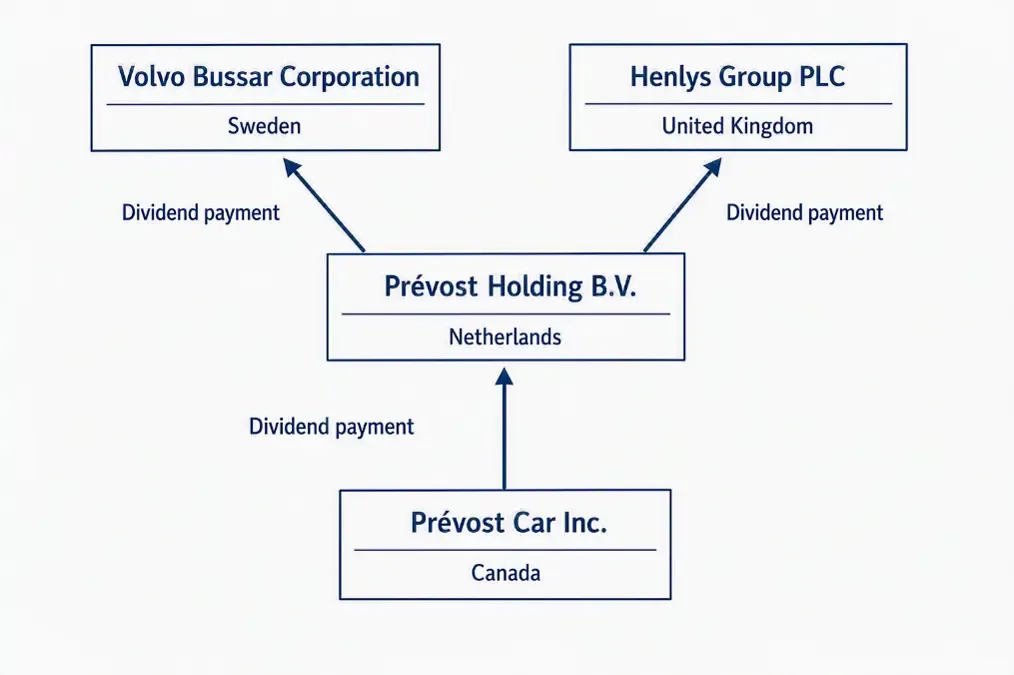
The Canada Revenue Agency argued that Prévost Holding B.V. was not the true recipient of the dividends paid by the Canadian company. In the Agency’s view, the Dutch entity functioned solely as a conduit company between the Canadian source of the income and the ultimate Swedish and British shareholders.
The Canada Revenue Agency argued that, although the dividends were legally paid to Prévost Holding B.V., the economic benefits were in fact intended from the outset for Volvo Bussar Corporation and Henlys Group PLC. It emphasized that the Dutch company subsequently distributed dividends in amounts substantially equivalent to those received from Canada.
On that basis, the Canada Revenue Agency considered the Swedish and British shareholders to be the true beneficial owners of the dividends and asserted that the Dutch company could not claim benefits under the Canada–Netherlands tax treaty.
Judgment
The Court rejected the Canada Revenue Agency’s position and held that Prévost Holding B.V. was the beneficial owner of the dividends.
In reaching that conclusion, the Court examined the Dutch entity’s legal position and noted that it was the legal owner of the shares in the Canadian company. It also found that the company received the dividends in its own name and for its own account.
The Court emphasized that no legal, contractual, or fiduciary obligation required Prévost Holding B.V. to transfer the dividends immediately to Volvo Bussar Corporation or Henlys Group PLC. Once received, the funds were under the Dutch company’s control and could be retained, reinvested, or distributed pursuant to decisions made by its corporate governing bodies.
The Court also stated that a company’s shareholders have no automatic right to dividends received by the company. Until a corporate distribution decision is made, the income belongs to the company that received it and remains under its control and economic risk.
The Court held that beneficial ownership identifies the person having the right to use, enjoy, control, and dispose of the income received. By contrast, a person acting solely as an agent, nominee, fiduciary, or mere intermediary required to pass funds on to a third party cannot be regarded as the beneficial owner.
In the case at hand, Prévost Holding B.V.’s subsequent dividend distributions to its shareholders did not demonstrate a pass-through obligation or turn the Dutch entity into a mere conduit company. Rather, the evidence showed that it had full legal capacity to determine how the funds received would be used.
For these reasons, the Court concluded that Prévost Holding B.V. was the beneficial owner of the dividends for purposes of the Canada–Netherlands tax treaty and was therefore entitled to the treaty benefits.
b) Royalties: Velcro Canada Inc. v. The Queen
Court: Tax Court of Canada.
Date: February 22, 2012.
Facts
Velcro Canada Inc., a Canadian-resident company, made royalty payments for the use of various trademarks, patents, and technologies employed in its business. The payments were made to Velcro Holdings B.V., a Netherlands-resident company in the Velcro multinational group.
The group’s corporate structure provided for Velcro Holdings B.V. to hold certain exploitation rights relating to the group’s intellectual property. The Dutch company also had contractual relationships with Velcro Industries B.V., a related entity resident in the Netherlands Antilles—a jurisdiction whose successor for purposes of this matter is now Curaçao—to which it made payments under intragroup agreements.
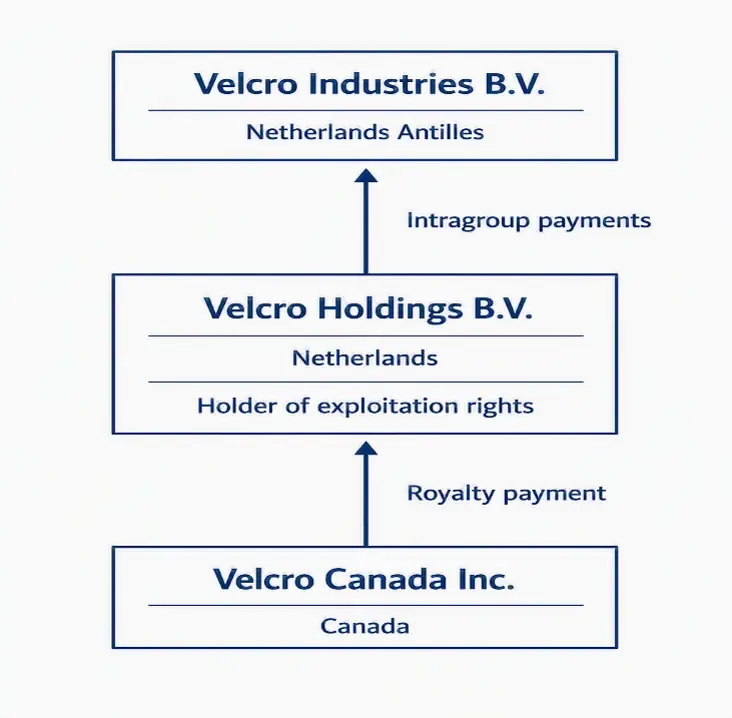
The Canada Revenue Agency argued that Velcro Holdings B.V. was not the beneficial owner of the royalties received from Canada. According to the Agency, the Dutch company functioned solely as a conduit company between the Canadian payer and the entity resident in the Netherlands Antilles.
The Canada Revenue Agency argued that a substantial portion of the royalties received by Velcro Holdings B.V. was ultimately transferred to Velcro Industries B.V. and that the Dutch entity therefore lacked a genuine economic interest in the income. On that basis, it asserted that the true beneficial owner of the royalties was the Netherlands Antilles entity rather than the Netherlands-resident company.
The Canada Revenue Agency therefore sought to deny the benefits of the Canada–Netherlands tax treaty on the ground that the Dutch entity acted solely as a conduit company.
Judgment
The Court rejected the Canada Revenue Agency’s position and held that Velcro Holdings B.V. was the beneficial owner of the royalties.
In reaching that conclusion, the Court examined the agreements among the companies in detail and found that Velcro Holdings B.V. received the royalties in its own name and for its own account. It also found that its payment obligations to Velcro Industries B.V. arose under independent agreements and did not entail the automatic onward transmission of the same amounts received from Canada.
The Court emphasized that a fundamental feature of a conduit company is an obligation that deprives the recipient of discretion over the disposition of the income. The evidence, however, showed that Velcro Holdings B.V. retained the legal and economic ability to use, manage, and dispose of the income received.
The Court also noted that the royalties entered the Dutch company’s assets, were deposited in its own accounts, and were subject to decisions by its directors. The entity assumed corporate responsibilities, maintained its own operations, and bore certain economic risks associated with its activities.
The Court stated that the subsequent payment of a significant portion of the amounts received to another group entity was not sufficient to deny beneficial-owner status. The relevant question was whether a legal or contractual obligation required the automatic onward transmission of the funds and eliminated the immediate recipient’s decision-making authority.
After reviewing the corporate and contractual documentation, the Court concluded that Velcro Holdings B.V. retained possession, control, use, and enjoyment of the royalties received. It therefore could not be regarded as a mere agent, nominee, or intermediary acting on behalf of another entity.
Accordingly, the Court held that Velcro Holdings B.V. was the beneficial owner of the royalties for purposes of the Canada–Netherlands tax treaty and was entitled to its benefits. This precedent is regarded as a leading beneficial-ownership case because it confirmed that subsequent payments within a multinational group are not sufficient to deny that status where the recipient entity retains control over, and the power to dispose of, the income.
Conclusion regarding both decisions
In both cases, the courts held that subsequent payments to shareholders or related entities were not sufficient to deny beneficial-owner status. The conclusion turned on the recipient’s retaining control over, and the power to dispose of, the income without being subject to a legal or contractual obligation to transfer it to a third party.

Author: Francisco Bracamonte, Tax-Legal Partner
Our goal is to build a network of trust with our clients to be the support in achieving business objectives. We are a network of firms with a presence in more than 110 countries, experts in offering tax, auditing, legal and accounting consulting services at national and international level. Everything written in this space is for the benefit of the readers; however, for a correct application of specific topics it is necessary to refer to our specialists. For more information visit www.krestonbsg.com.mx
Related Blogs


